What Do Full Mouth Veneers Really Look Like Before and After?
What Full Mouth Veneers Look Like Before and After
Full mouth veneers before and after results usually show a brighter, more even smile. Veneers can cover stains, chips, small gaps, and uneven tooth shapes across the visible teeth. They can also make mildly crooked teeth look straighter, but they do not move teeth or replace missing ones. When reviewing photos, compare the tooth shape, color, and gumline, not just the brightness of the smile.
I’m Dr. John Hegazin, owner of Bradenton Implants & Smile Center, with more than eight years of experience providing personalized dental care, including veneers and smile makeovers. I’ll explain what full mouth veneers before and after photos can show, what they cannot show, and how to judge whether the result fits your needs.
What to Expect from Full Mouth Veneers Before and After
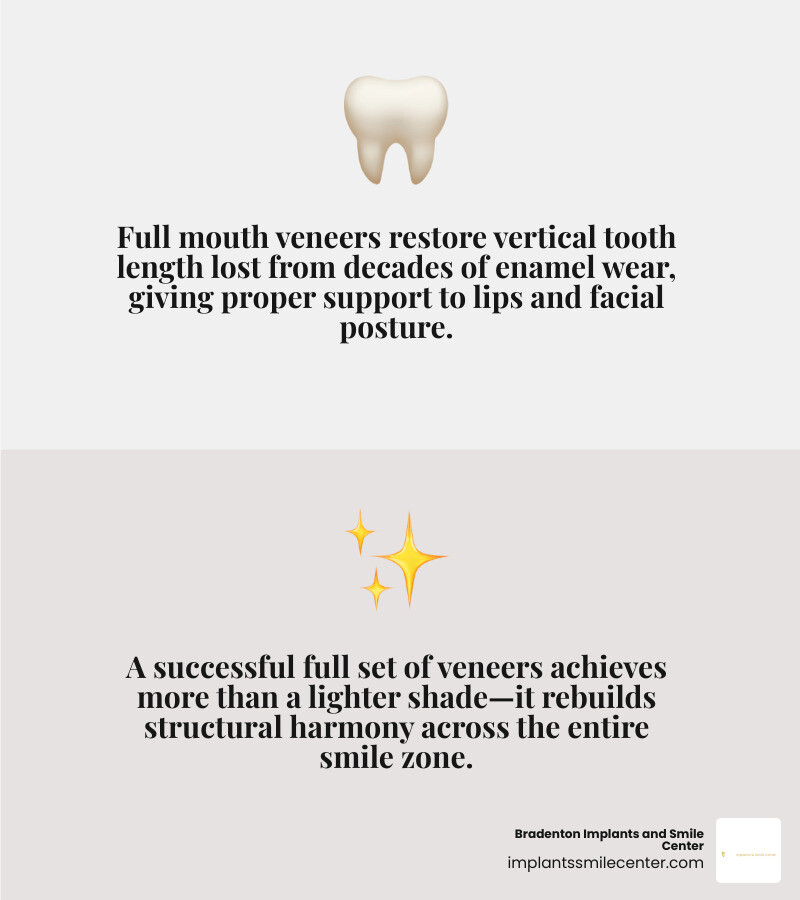
When people look at transformations in our full mouth smile makeover portfolio, they often focus entirely on the dazzling white finish. However, a successful full set of veneers achieves much more than just a lighter shade. It rebuilds structural harmony across your entire smile zone.
Over decades of chewing, grinding, or exposure to acidic foods, natural teeth experience significant enamel wear. Edges become jagged, flat, or translucent, making the lower third of the face appear prematurely aged. Full mouth veneers restore that lost vertical length, giving proper support back to your lips and facial posture.
Beyond rejuvenating worn enamel, full arch veneers address complex aesthetic challenges simultaneously:
Severe intrinsic staining: Discoloration caused by deep trauma or medications like tetracycline rarely responds to peroxide bleaching alone. Veneers mask these dark internal bands permanently.
Multiple diastemas: Uneven spacing and wide gaps across several front teeth are closed without years of orthodontic bands.
Minor crowding and rotation: Mild misalignments are visually straightened within a few short weeks.
Visual balance: Every tooth is shaped proportionally relative to your facial midline, lips, and eye line.
Analyzing Dental Flaws in Full Mouth Veneers Before and After Cases
Evaluating genuine case photographs requires an eye for anatomical nuance. When you look at authentic photographic evidence, pay attention to the underlying dental flaws that were resolved.
Patients presenting with enamel hypoplasia—a condition where enamel forms defectively in pitted, thin, or discolored patches—often struggle with tooth sensitivity and an uneven surface texture. In real cases, you can see how ultra-thin ceramic shells create a silky, glass-smooth exterior that resists future plaque accumulation.
Chipped incisal edges from everyday accidents or habitual nail-biting disrupt the smile curve. A custom veneer treatment lengthens these teeth evenly, following the natural curvature of the lower lip. Furthermore, if your natural dental midline deviates slightly to the left or right, custom ceramic placement can gently recalibrate the visual balance, guiding the viewer's eye to a centered, harmonious presentation.
Single Unit vs. Full Arch Cosmetic Coverage
A common question we hear during aesthetic consultations is why someone should consider a full set instead of fixing just one or two flawed teeth.
Treating a single central incisor with a veneer is one of the most challenging tasks in aesthetic dentistry. Natural teeth possess unique gradients, micro-textures, and optical characteristics that shift as lighting changes throughout the day. While our master ceramists can match a single tooth beautifully, placing veneers across the entire visible smile zone—typically 8 to 10 teeth per arch—provides complete artistic control over the arch symmetry.
Treatment Scope | Teeth Treated | Aesthetic Control | Best For |
|---|---|---|---|
Single Unit | 1 tooth | Moderate (requires exact color match to adjacent teeth) | Isolated trauma, single discolored tooth |
Partial Arch | 4 to 6 teeth | High (covers the front center smile) | Front gap closure, central incisor crowding |
Full Arch / Full Mouth | 8 to 10+ teeth per arch | Maximum (unifies shade, buccal corridors, and smile line) | Total smile restoration, severe wear, broad smiles |
When you treat the entire smile line, you eliminate mismatched shades between the front teeth and premolars. You also fill in the dark buccal corridors—the shadow spaces visible in the corners of your mouth when you smile broadly. For a deeper breakdown of how many units fit different smile types, explore our veneers complete guide.
Evaluating Materials and Aesthetic Outcomes
Not all ceramic restorations look or behave the same way. The artistry of modern cosmetic dentistry relies heavily on selecting advanced dental ceramics that mimic the natural optical traits of human enamel.
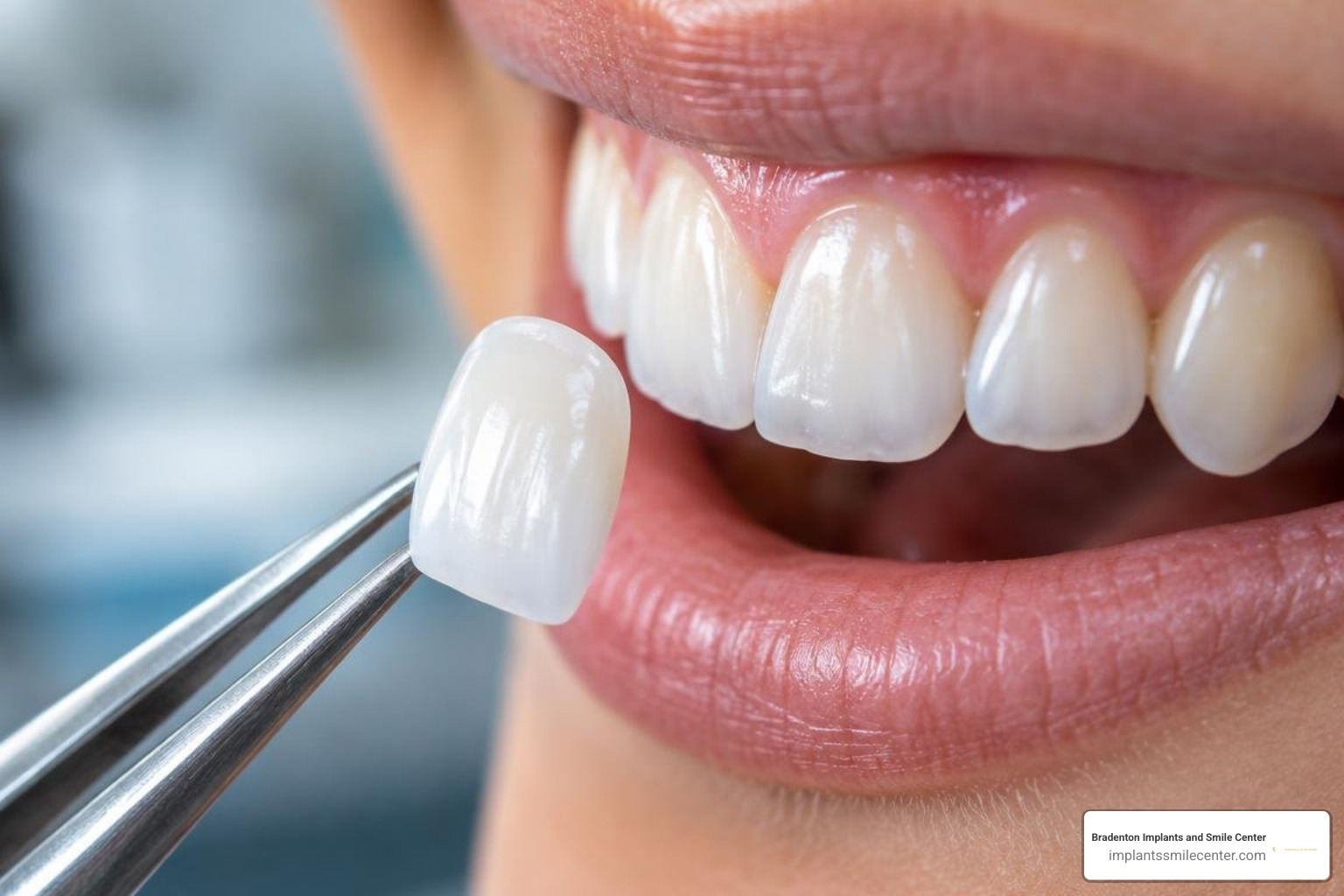
Natural enamel is translucent; it allows light to penetrate the surface, bounce off the underlying dentin, and reflect outward. If a dental material is too opaque, teeth look like chalky white chiclets. If it is too translucent, underlying gray stains shine right through. Balancing ceramic durability, light refraction, and biological compatibility ensures your smile looks authentic in sunlight, candlelight, and camera flashes alike.
Porcelain, E-Max, and Zirconia Comparisons
Depending on your bite force, cosmetic goals, and underlying tooth shade, we choose from several premium dental materials:
Feldspathic Porcelain: The traditional choice for handcrafted aesthetic layering. It offers unmatched natural beauty and fine texture, making it ideal for patients with minor discoloration and a balanced bite.
Lithium Disilicate (E-Max): An extremely popular glass-ceramic renowned for its strength and lifelike translucency. E-Max veneers can be pressed exceptionally thin, preserving more of your natural enamel during preparation while resisting everyday chipping.
Layered Zirconia: Zirconia provides exceptional fracture toughness. It is often the material of choice for patients who have heavier bites or severe internal dark staining, as its core effectively blocks dark discoloration while a porcelain overlay provides surface luster.
Material | Aesthetic Quality | Flexural Strength | Enamel Reduction Needed | Ideal Patient Profile |
|---|---|---|---|---|
Feldspathic Porcelain | Exceptional (high translucency) | Moderate (~100–150 MPa) | Minimal to Moderate | Low bite force, subtle cosmetic refinements |
E-Max (Lithium Disilicate) | Excellent (lifelike depth) | High (~400–500 MPa) | Minimal (0.3mm–0.5mm) | General cosmetic cases, gap closures, moderate wear |
Layered Zirconia | Very Good (masked core + aesthetic veneer) | Maximum (900+ MPa) | Moderate (0.5mm–0.8mm) | Heavy biters, dark underlying stains, bridge restorations |
Alternative Cosmetic Solutions for Total Smile Restoration
While full mouth veneers create dramatic transformations, they are not the only pathway to a restored smile. We believe in presenting every viable option so you can make an empowered decision about your oral health.
Non-Invasive Brightening: For patients whose primary concern is surface yellowing without structural chips or alignment issues, starting with professional whitening and cleaning may achieve the desired shade without altering your natural enamel.
Full Coverage Restorations: When teeth have large, failing fillings, recurrent decay, or have undergone root canal therapy, a veneer may not offer enough structural support. In these situations, customized dental crowns provide 360-degree protection, reinforcing fragile tooth structure while delivering the same radiant ceramic finish.
Clinical Process and Treatment Stages
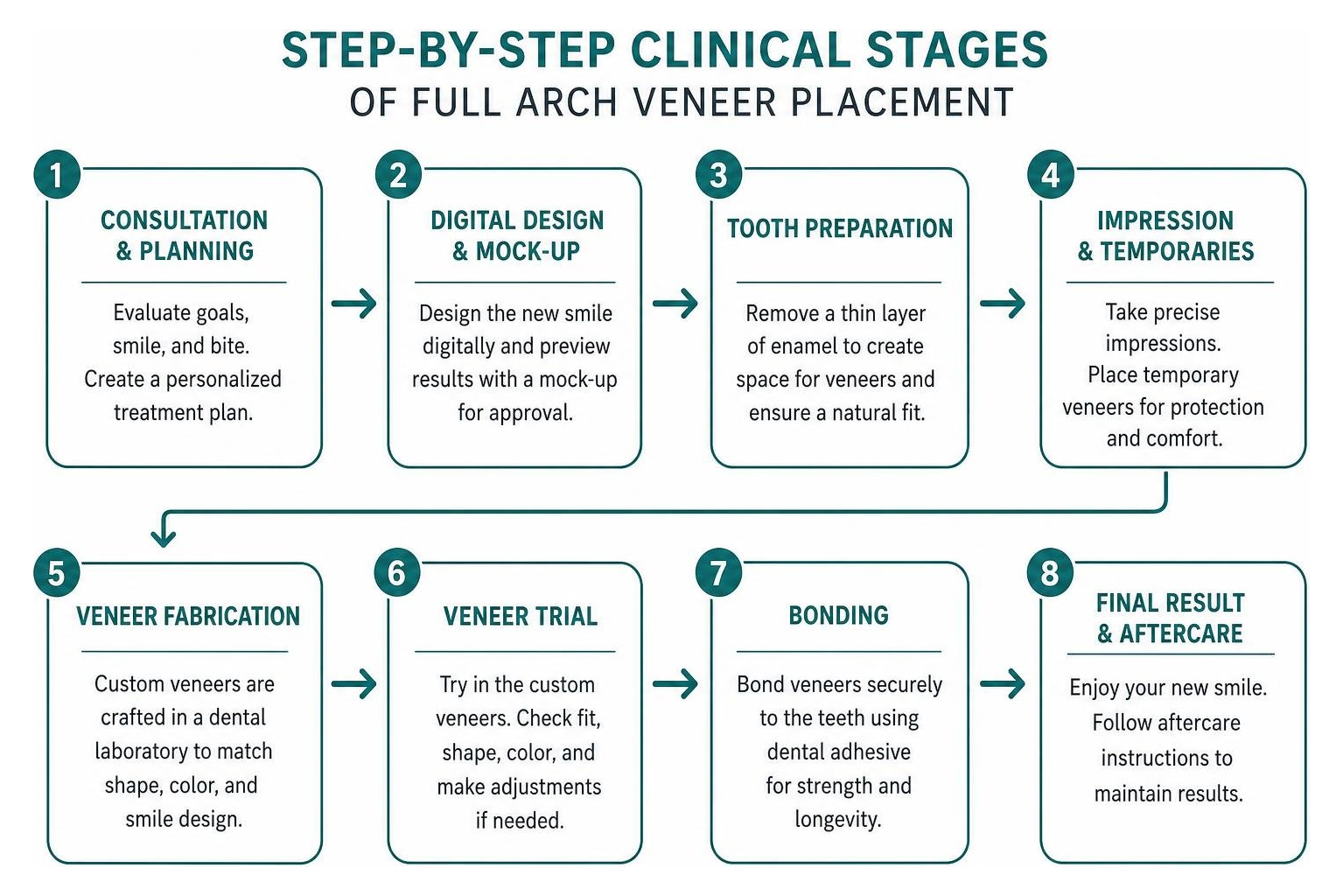
Transforming a smile with full mouth veneers is a collaborative, step-by-step clinical process. It combines advanced digital engineering with bespoke dental artistry to guarantee predictable results.
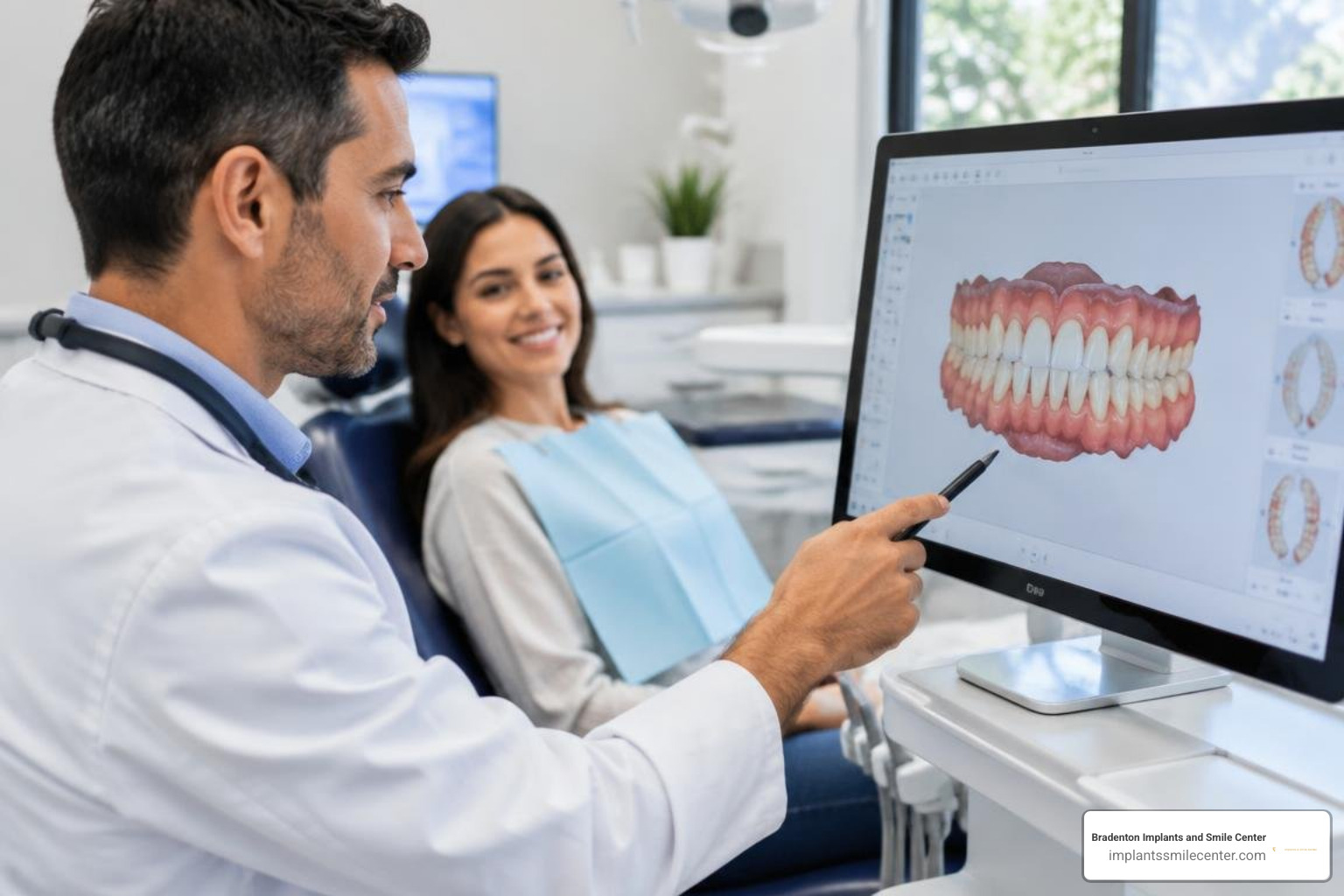
Digital Smile Design and Diagnostic Mockups
Your transformation begins with an in-depth consultation and comprehensive digital planning. We evaluate your facial dimensions, lip posture, phonetics, and bite dynamics.
Using high-resolution intraoral scanners, we capture precise 3D digital impressions of your teeth—no messy, gag-inducing putty required. From these scans, we create a Digital Smile Design (DSD) mockup. This allows you to preview your projected outcome on screen and even test-drive a temporary physical version in your mouth before we make any permanent alterations to your teeth. You get to approve the tooth length, shape, and shade before laboratory fabrication begins.
Once the design is finalized:
Tooth Preparation: We gently shape a fraction of a millimeter of enamel from the front surface of your teeth to ensure the final veneers sit flush with your gumline.
Temporary Veneers: You wear temporary restorations crafted from the diagnostic mockup. This trial smile lets you evaluate your new look, test your speech, and verify comfort in daily life.
Master Craftsmanship: Our dental laboratory fabricates your permanent veneers using high-grade ceramic ingots, hand-layering micro-textures and subtle translucencies.
Permanent Bonding Protocol: We isolate each tooth, clean the enamel, apply specialized bonding resins, and cure them with a high-intensity light to lock your new smile permanently in place.
Recovery Expectations in Full Mouth Veneers Before and After Reviews
After your bonding appointment, your mouth needs a short period to adapt to its new contours:
Gingival Adaptation: Your gums may feel slightly tender or appear pink and inflamed for a few days following the placement procedure. Warm saltwater rinses and gentle brushing help the soft tissue settle quickly around the ceramic margins.
Bonding Sensitivity: It is normal to experience temporary sensitivity to hot and cold temperatures for the first week or two. This subsides as the teeth adjust to the bonding materials.
Bite and Speech Adjustment: Because your teeth may be slightly longer or shaped differently, making sounds like "S" and "F" might feel unusual for 48 to 72 hours. Your tongue and lips adapt rapidly to the improved contours.
Longevity, Combined Treatments, and Financial Investment
When planned accurately and bonded to healthy enamel, high-quality porcelain veneers provide outstanding longevity. Clinical data confirms that well-maintained ceramic veneers regularly last 10 to 15 years, and often beyond 20 years with diligent care.
Preserving your investment involves simple, consistent oral habits:
Brush twice daily with a non-abrasive fluoride toothpaste to prevent scratching the ceramic glaze.
Floss daily around each restoration to protect the underlying natural tooth structure and gum margins.
Wear a custom nightguard while sleeping if you have a history of clenching or nocturnal bruxism.
Keep up with routine cleanings and checkups every six months so your dental team can monitor marginal integrity.
Comprehensive smile design often involves more than just placing porcelain shells. In many cases of full mouth cosmetic dentistry, we combine therapies to establish optimal foundation health.
Combining Veneers with Gumline Assessment and Implants
A beautiful smile requires a healthy frame. If you have an uneven gumline or a "gummy" smile, we perform a gentle gumline assessment before placing veneers. Minor laser recontouring can level the gingival margins, creating symmetrical tooth lengths across the entire arch.
When patients present with both worn front teeth and missing posterior teeth, we integrate treatments seamlessly. Missing teeth compromise bite stability, which can put undue stress on new front restorations. By placing cosmetic full mouth implants to restore missing molars, we re-establish proper chew support and bone integration. Once your foundation is stable, we place matching veneers on your front teeth for a uniform, functional result.
Cost Variables and Long-Term Value
The financial investment for full mouth veneers reflects the individualized care, material quality, and technical expertise required for multi-unit cases.
Key factors influencing overall treatment costs include:
Number of Restorations: Treating 8, 10, or 20 teeth across both arches.
Material Selection: Ultra-aesthetic E-Max or layered zirconia ceramics crafted by master technicians.
Preparatory Procedures: Necessary foundation work such as laser gum sculpting, bite equilibration, or decay removal.
Diagnostic Planning: 3D imaging, digital previews, and physical mockups.
We believe financial considerations should never stand between you and a healthy, confident smile. Our team works closely with patients to discuss transparent treatment pricing, flexible third-party financing arrangements, and warranty coverage options that fit your budget.
Frequently Asked Questions About Full Mouth Veneer Results
How Long Do Full Mouth Veneers Typically Last?
With good oral hygiene, routine dental visits, and the use of a protective nightguard if you clench your teeth, high-grade porcelain veneers typically last between 10 and 20 years. Maintaining healthy gums and avoiding habits like chewing ice or using teeth as tools will keep the restorations secure and beautiful.
What Is the Difference Between Veneers and Full Mouth Crowns?
Veneers are conservative shells that bond primarily to the front and biting edges of your teeth, requiring minimal reduction of natural enamel (often 0.3mm to 0.5mm). Full mouth crowns cover the entire 360-degree circumference of a tooth down to the gumline, which requires more tooth preparation and is reserved for teeth with significant structural damage, large fillings, or prior root canals.
Can Full Mouth Veneers Be Replaced if Damaged?
Yes. If an individual veneer chips, cracks, or debonds due to trauma, it can be carefully removed and replaced without disturbing the surrounding restorations. Your dentist will take a digital scan, remove the residual bonding material, and order a replacement unit calibrated to match the exact shade and shape of your existing smile.
Conclusion
A full arch or full mouth cosmetic transformation provides more than just a cosmetic upgrade—it restores worn enamel, improves facial balance, and delivers life-changing self-confidence. Evaluating real transformation examples reveals how modern dentistry blends structural precision with natural beauty to create results that never look artificial.
At Bradenton Implants & Smile Center, we are dedicated to providing personalized, compassionate care using the latest digital technologies and premium ceramic materials. If you are ready to explore your options, schedule a consultation with our experienced team to design your custom dental veneers and start your journey toward a radiant, lasting smile.